It didn’t hurt. It did instantly send me from a 4 to a 10.
One breath in, one breath out. Not long enough.
“What do you think you are doing?!”
I can see the path I’m going to take, as if my brain has hijacked me.
At this point, I’m barely aware of it, although I do recognize it.
I can see the space to think and the choice to respond gently instead of acting harshly for less than a flash, and then the space is gone.
Despite all of the other times before, where I have taken a second or third breath and remembered to think and choose, I stop being in control.
I’m sick with a cold. I’m exhausted. I’m annoyed. And now, I’m pissed off.
The object of my rage is my almost 7 year old. It feels good not to be in control. Until it doesn’t.
I slowly turn around. A tug in my brain to parent differently. I ignore myself.
“Do you honestly think that was the right choice to make right then?”
My voice sounds too controlled and calm. I’m no longer thinking. I’m all reaction.
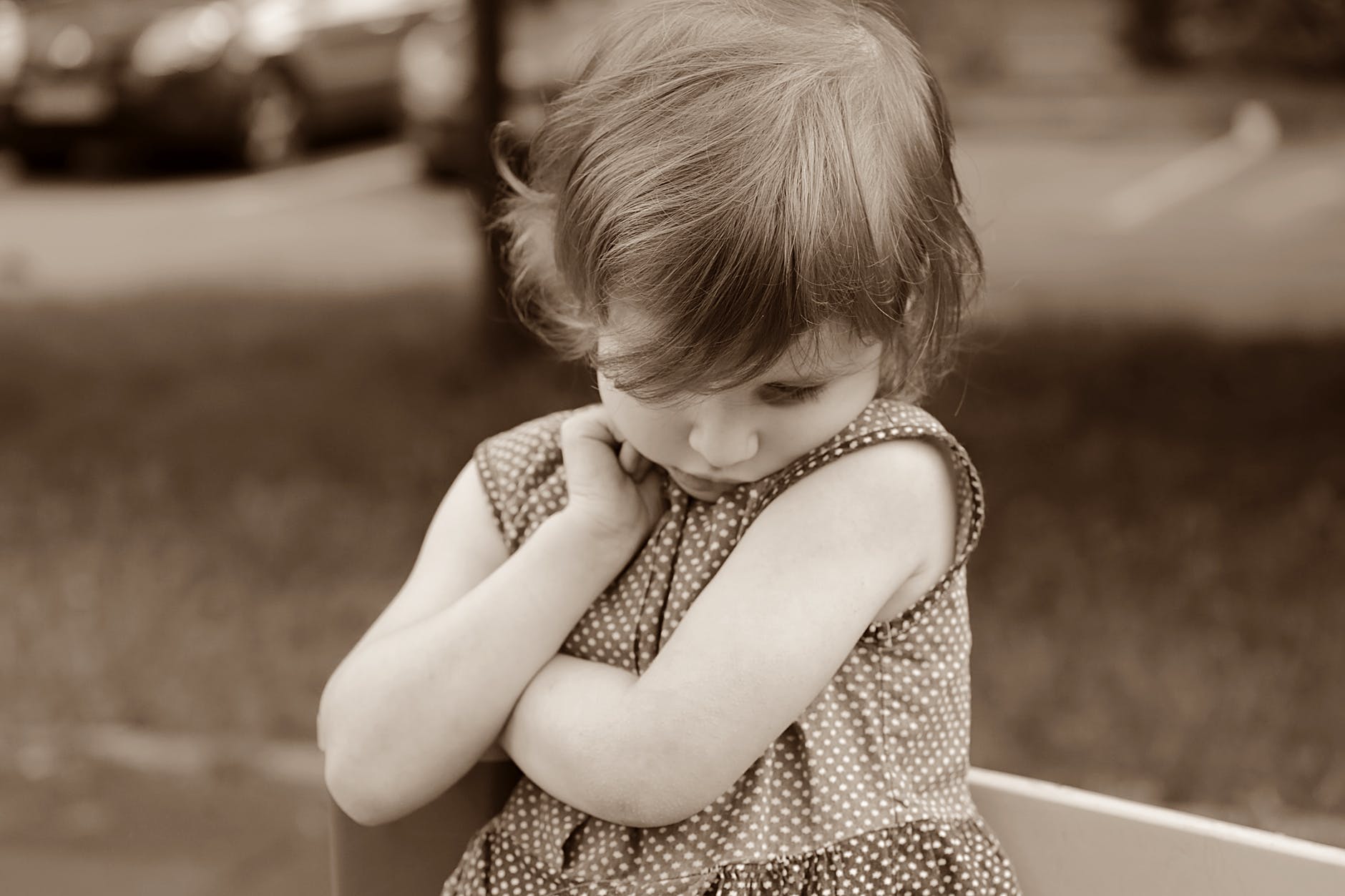
6 seconds of kicking, screaming, and crying while I physically lift her from my bedroom to her bed, where I let out my anger 6 times on her back end.
Losing my temper.
Then I just stop. I remember too late that this isn’t how I want to parent.
I recognize the fear and pain, and this time, I’m causing it.
I stop hitting, but I’m still too angry to be considered safe right now. The shame of losing it this much is settling in, and it’s not helping me.
I am being too loud. Too aggressive. Too threatening. Too much like my own mother.
Clarity.
I back out of her room and tell her to stay there until her father gets home tonight.
That’s too long. I know it is. Even as I say the words, I know I don’t mean them.
I just have nothing else in my toolkit right now.
A seven, almost eight year old doesn’t have the mental or emotional maturity to calm me, a full-grown adult down. Nor should she. It’s not fair to expect from her what I’m not capable of modeling.
Her reaction understandably escalates until I close the door and take the time I should have taken at the beginning to breathe, think, and choose my actions.
I’m calm now. I’m safe again. I haven’t lost my temper like this in a few years, so I’m definitely making some progress.
Of course, I wish I never got here to begin with.
I have damage control to do.
As much as we try to justify our actions as parents, at the end of the day, our kids learn from what we do more than anything we will ever say.
Before I knock on her door. She slips me an apology note under it. My heart breaks. I’m already laying the foundation for trauma instead of peace. I somehow stop myself from spiraling.
When I go back to apologize, I tell her how proud I am that she thought to apologize first when she was so upset herself.
“Apologizing is hard, and I am so proud of you for being able and willing to take the first step.”
I tell her that I’m sorry too. That even if she hit me first, I’m the adult, and it isn’t ok for me to hit her back.
I let her know that although I’m still not happy with her being ungrateful, I can see now that I made the wrong choice completely on how to address that.
I promise to do better. And I will do better.
It’s not easy to break cycles.
Sometimes, learned behavior seeps through even when you have the best of intentions.
Sometimes, you will make the wrong choice or do the wrong thing, despite knowing the damage and the pain it causes.
It’s important to acknowledge those moments.
It’s important to never pretend them away.
It’s important to not continue the cycle just because breaking the cycle is so hard. Never give up. Always try to do better.
No one is perfect. We need to model the same grace we want our children to live with ourselves.
If anything good comes from me losing it, it’s that my daughter knows I understand her temper. She knows that mommy loves her even after she loses her temper, too. Even after 35 years of practice, mommy still messes up, so it’s ok if they mess up with only 7 or 10 years of practice.
Acknowledged mistakes are half the battle.
Apologizing to your children when you make the wrong choice and it impacts them will build their trust in you.
We aren’t trying to be perfect. We are trying to be whole.
I wrote this piece a few months ago while I was in therapy. I was trying to pin-point the source of my constant anxiety. With so many gaps in my memory from my childhood, these are the most vivid memories that often present in the form of recurring dreams. There is a lot alluded to, but I don’t know how much of these memories to trust as actual fact.
Sometimes they wash over you like a cloud rolls across the sky on a cool spring day. They give you just the faintest outline of an image, that if stared at too long becomes distorted, but if half ignored takes shape in the most marvelous of ways.
Sometimes they are so jarring that you wake up in the middle of the night. Heart pounding. Palms sweaty. Nervous. Anxious. Not able to remember what caused the reaction, but absolutely certain it was terrible.
Sometimes they bring a smile to your lips. A sparkle to your eyes. You are lost in a moment of nostalgia. You can recall every word, every detail, every sound, every smell. And you never want to forget.
Sometimes, you push them away. You don’t want to remember. You try to distract yourself. You force your mind to focus on other things. You remember, but you desperately want to forget.
A seemingly unrelated event brings everything rushing back.
The strange, metal, army green chest and the single bed. The bedroom that had nothing else in it. But where was it? Why were you alone? Why were you afraid? Was it even real?
The whispers. The looks. The sadness. The anger.
The fat lady singing about a fire. Being woken up because you had to evacuate because a gas station down the road actually did catch fire.
The questions that suggest something terrible and unspeakable might have happened to you. But you don’t know. There’s a gap, a blank, a void. You want to remember, to put the questions at ease, but you don’t trust what’s real and what’s imagined.
The punishments for being a kid. Being forced to double over backwards as a time out. Until the pain became so unbearable you give in to the spanking for moving because that’s better than the numbness you feel.
The fear of doing anything wrong.
Ever.
You might think people are nice, but if you make them angry, they might become someone you don’t recognize. You just don’t want to take that chance.
The recurring dream of there being a secret passageway in your school’s cafeteria. If you find it, you can finally escape. But, you can also get lost and never be found.
The realization that you are just a shell of who you want to be, because you are scared of what your genes might have made you.
Am I strong enough to change history for my own family?
They aren’t all bad. You know there are some hidden good ones scattered here and there. The problem is braving the process. Not knowing what will trigger a fleeting image. The eternal impact.
The yellow big bird slippers that only had one eye. The doll house, that you loved, but don’t remember, other than it being given to you.
Your babysitter’s son telling you that you have to do what he says or you will be in trouble, then being led into his bedroom. You can only imagine what happened next, because like so much else, everything after that point is blank in your mind.
You want them to stop. But you also want to understand.
I am a survivor of childhood abuse and trauma. For some, including myself, this is a revelation. For others, it is not.
Most people are aware of what physical abuse and sexual abuse are, and most people would agree that those types of abuse are absolutely wrong.
It is even easier to define and understand what constitutes physical and sexual abuse. There is little room for “grey” areas. The resulting injuries are more obvious, are more immediate, and are more difficult to ignore.
Emotional abuse, also referred to as mental, or psychological abuse, is a different story.
Emotional abuse is behavior based. One definition states that emotional abuse is characterized by a person subjecting or exposing another person to behavior that may result in psychological trauma, including anxiety, chronic depression, or post- traumatic stress disorder.
Psychology Today suggests that often, an emotionally abusive person is not aware that they are being abusive.
I think it is very important to note that there is a significant difference between a healthy expression of negative emotions, and emotional abuse.
The difference is the control factor.
It has taken me a long time to realize that feeling and expressing negative emotions is healthy and normal. What is not normal is trying to ignore any and all negative emotion, leaving it bottled up inside of you, until it explodes with little to no provocation down the road.
It is normal, healthy, and okay to tell people how you feel. It is not normal, healthy, or okay to use those negative emotions to try and manipulate or control the actions or behavior of others. At that point, is when you have crossed the line and have entered the territory of emotional abuse.
Let me give some examples based loosely off of my personal life to better demonstrate the difference. These are in no particular order, and may or may not be attributed to me directly.
The Scenario:
A child eats something in her parents’ bed while watching T.V. The child accidentally gets crumbs in the bed.
The Reaction:
The mother finds the crumbs in her bed, and is understandably frustrated at the increased housework involved with needing to change her sheets, despite having told the child previously to not eat in bed. The mother decides an appropriate punishment would be to take a package of crackers and crumble them up in the child’s bed, and then force the child to sleep in the mess so that the child understands why she isn’t supposed to eat in bed in the first place.
The Conclusion:
It is normal and healthy to be frustrated with crumbs in your bed. It is abusive to retaliate on the level of putting crumbs in a child’s bed and forcing the child to sleep in it.
An appropriate alternative would have been to give a time out, or to require that the child clean up her own mess.
The Scenario:
A teenage daughter comes home from school, excited at the prospect of finally being allowed to go visit her friends after school. The permission for this visit is rare, and requires the mother to drive the daughter to her friends’ house. When the daughter walks in the door, she finds the mother in one of her bad moods, over something that was beyond the daughters’ control. The daughter recognizes the situation and realizes that she will have to cancel her plans again. The daughter expresses her disappointment and asks why.
The Reaction:
The daughters’ question is met with rage from the mother, and is told that the decision is because the mother is the mother, that’s the way things are, and if the daughter doesn’t like it, the daughter can leave.
The Conclusion:
Punishing someone for something that they had no part in and for something that they could not control is emotional abuse. Taking your anger and frustration out on your daughter simply because you are the mother and can, then reacting to a normal expression of disappointment with more anger and threats is emotional abuse.
The appropriate and healthy alternative would have been to go to the root cause of the original frustration and work it out, without denying the daughter something she was looking forward to.
The Scenario:
An adult daughter has a disagreement with her emotionally abusive mother. The adult daughter recognized that her own part in the interaction is becoming too emotional, so she chooses to end the interaction until she has a chance to calm down and look at the situation more rationally. The mother becomes enraged that that the daughter has set boundaries and is keeping those boundaries.
The Reaction:
The mother chooses to make the disagreement public. The mother chooses to use criticism, shaming, and blaming techniques, delivers a false narrative of events in an attempt to gain sympathy from onlookers and to manipulate and control her daughter’s response. The mother refuses to accept her part in the disagreement, and shifts to name calling whenever the daughter attempts to defend herself. Ultimately, the mother withholds affection and refuses to communicate at all.
The Conclusion:
Nothing about the previous reaction was healthy or normal. In fact, it demonstrates nearly all 10 signs of emotional abuse in relationships.
The appropriate alternative would have been to take some time to calm down, admit her part in the interaction, and avoid going public in an attempt to shame and humiliate.
So, what are the 10 signs of emotional abuse? Psychology Today lists them as follows:
Constant criticism or attempts to manipulate and control.
Shaming and blaming with hostile sarcasm or outright verbal assault.
The use of shaming and belittling language.
Verbal abuse- name calling.
Withholding affection.
Punishment and threats of punishment.
Refusal to accept your part in the dynamic.
Mind games, such as gas-lighting, when it comes to accepting personal responsibility for your own happiness.
Refusing to communicate at all.
Isolating from supportive friends and family.
The parent/child dynamic is complicated.
Society expects there to be an unbreakable bond between children and parents. Children are supposed to show their parents unwavering loyalty, regardless of the situation or circumstances.
In many cases, the survivor of childhood emotional abuse doesn’t recognize the abuse until they are adults. When the revelation does occur, it is heart-breaking. The adult child is finally able to realize and accept that they were never the issue to begin with, despite efforts from the abuser to make them believe the opposite.
The adult survivor of childhood abuse experiences an awakening moment. They become more fully self-aware and hyper-vigilant that they don’t cause the same level of pain that they have experienced.
This revelation, in and of itself, comes with its own unique set of hurdles that must be overcome. You may not get the closure you need.
Anxiety and depression finally make sense. Living in a constant state of fight or flight has very real emotional and physical consequences.
The headaches and stomachaches you’ve experienced, but don’t seem to have a medical cause, may have an emotional one instead.
Brain fog, or the inability to remember your past, is a real indicator. Children possess the unique ability to block trauma as a coping mechanism. These blocked or suppressed memories are often revealed as adults through high stress events that trigger the release of all of the emotions that go along with the memories.
Survivors may also have experience with being socially withdrawn, lacking in self- confidence, and having low self-esteem.
When an adult survivor realizes that their own parent may be the perpetrator of the abuse they have experienced, they may go through a period of denial. This period of denial can also be related to the common cycle of abuse. They will confront the parent in question, which will cause a sort of reprieve wherein everything seems to get better, and the survivor of abuse begins to doubt their own memory of events, or think that things aren’t really as bad as they are. That lasts until the next time the survivor feels that boundaries are being crossed, and re-establishes those boundaries. At that point, things don’t get better as they did previously. Instead, they get worse, and the adult child is left with the realization that they were right to begin with.
Understanding this doesn’t lessen the difficulty of accepting that those who are supposed to protect you from harm have either advertently or inadvertently, caused the harm you have experienced.
The adult survivor will want to prove themselves wrong. They will want to convince themselves that things weren’t really as bad as they remember, or don’t remember.
The adult survivor will seek reconciliation with their abuser. This will be done with the hope that the abuse will be admitted, and that a true parent/child relationship can be established.
The adult survivor will experience further abuse in the form of shame and judgement for having the courage to name the abuse for what it is, and exposing their abuser.
The adult survivor will blame themselves. They will look for the link between their actions and the subsequent abuse, no matter how small, and will use that as proof that the problem is really with them, and not the abuser.
For example, if I didn’t hang up on my mother in an attempt to establish my boundaries, she wouldn’t have made our argument public, and I wouldn’t be experiencing the level of guilt, shame and embarrassment that I am.
The adult survivor will have already grieved. With the realization that the abusive parent is either not able to recognize the abuse for what it is, or is not willing to admit it, the adult survivor will let their hope for a healthy relationship die. They will accept the situation for what it is, and they will mourn the loss of the relationship they wanted, but could never have.
This one is a little bit harder to understand unless you have experienced it. Well-meaning people will admonish you to let go of the anger, not realizing that there is no real anger, only a deep and profound sadness. They will say that their stance is because they don’t want you to have any regrets. What they don’t understand is that you have already experienced all of the regrets, and they were regrets that you had no control over. For the sake of your health, you are letting the toxic people and experiences go, and with that conscious decision comes a rare sentiment of freedom and relief.


 The Ashley Smith Blog